What Are the Readings on a Multimeter for a 2s Lipo Battery Should Read
Foreword
This guide, written over the course of years, has one sole aim: to educate hobbyists new and old well-nigh LiPo batteries with a focus on safety. The guide and I have been criticized over the years for "misleading" people on the dangers of LiPo batteries or the practices of charging, using, and storing them. Some of these criticisms were justified, and the guide changed to better reflect reality (see the changelog at the lesser for details of those changes). Some of the attacks were non justified and came from those in the industry whose concern I was disrupting past recommending against sure practices. In those cases, the guide was not inverse. My only interest in keeping those who come to us for guidance safe and educated, with no exceptions. So read on, learn, inquire questions, and be condom!
Here are another manufactures you may find interesting later you acquire about LiPo batteries:
A Guide to Traxxas' Batteries & Chargers
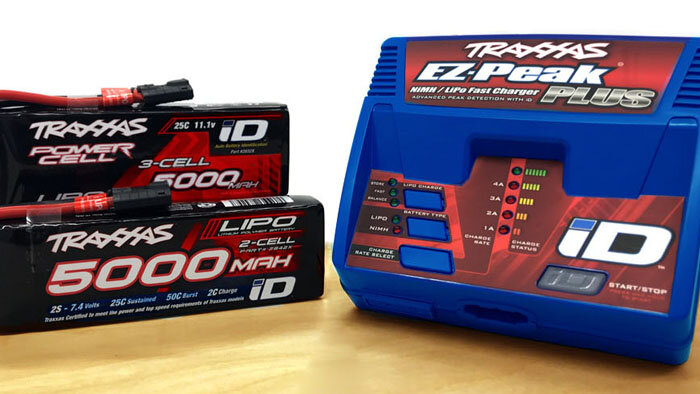
Now that purchasing a Traxxas vehicle also ways using their batteries and chargers, agreement Traxxas' batteries, chargers, and accessories is important for all Traxxas owners. In this guide, nosotros'll go over Traxxas' batteries — both Nickel-Metal Hydride and Lithium-Polymer — the Traxxas iD applied science, and finally, Traxxas' chargers and how to utilise them.
R/C Gearing 101
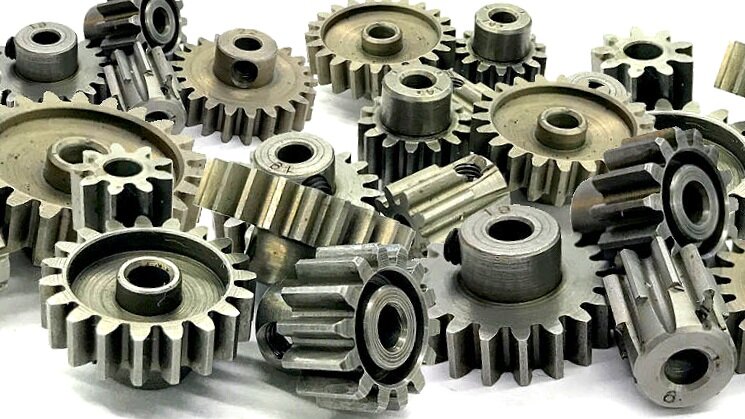
1 of the questions we become asked a lot has to exercise with gearing; how it works, what happens when I put this gear on that, can I get ameliorate runtimes if I change the gearing, etc. It can be a bit of a nightmare to effigy out how all-time to gear your truck, merely with a little math and a calculator, you lot can be a gearing expert in no time — or at least good enough to accomplish what you're shooting for.

How to Maximize Your Run Time
One thing that is universal for anyone that runs electric R/C cars and/or trucks is a desire for more run time. It seems like in that location is no such thing as too much run time, but there is an optimal way to amend the amount of running time you can become with your R/C vehicle. This guide seeks to explain those best practices in an outgoing way. So let's get into it!
Introduction
Lithium Polymer (AKA "LiPo") batteries are a type of battery now used in many consumer electronics devices. They accept been gaining in popularity in the radio control industry over the last few years and are at present the most pop choice for anyone looking for long run times and loftier power. LiPo batteries offer a wide array of benefits, but each user must decide if the benefits outweigh the drawbacks. For more and more than people, they do. In my personal opinion, there is nothing to fright from LiPo batteries, then long as you follow the rules and treat the batteries with the respect they deserve.
This guide was written after many hours of enquiry. It is every bit accurate every bit I can make it without actually being a chemical engineer (though in researching this commodity, I did talk to a few of them). That said, this guide isn't intended to be taken equally definitive. It is a living document, and as mutual knowledge regarding LiPo batteries changes, so likewise will this guide.
Let'due south first talk well-nigh the differences between LiPo batteries and their Nickel-Cadmium and Nickel-Metal Hydride counterparts.
LiPo Batteries
Pros
-
Much lighter weight, and tin be made in almost any size or shape.
-
Much higher capacities, assuasive them to hold much more free energy.
-
Much college discharge rates, significant they pack more dial.
Cons
-
Much shorter lifespan; LiPos average only 150–250 cycles.
-
The sensitive chemistry can atomic number 82 to a fire if the battery gets punctured.
-
Need special care for charging, discharging, and storage.
NiMH Batteries
Pros
-
Longer lifespan than LiPos, usually into the 1,000 cycles range
-
Much less sensitive, and doesn't usually pose a burn down risk
-
Simpler chargers and routines are required for use.
Cons
-
Much heavier, and limited on size.
-
Lower average chapters, and less efficient overall.
-
Lower discharge rates; they lack tremendous punch.
What Do All the Numbers Mean?
The manner we define whatever battery is through a ratings system. This allows us to compare the backdrop of a battery and help us determine which battery pack is suitable for the demand at hand. There are three main ratings that y'all demand to exist aware of on a LiPo battery.
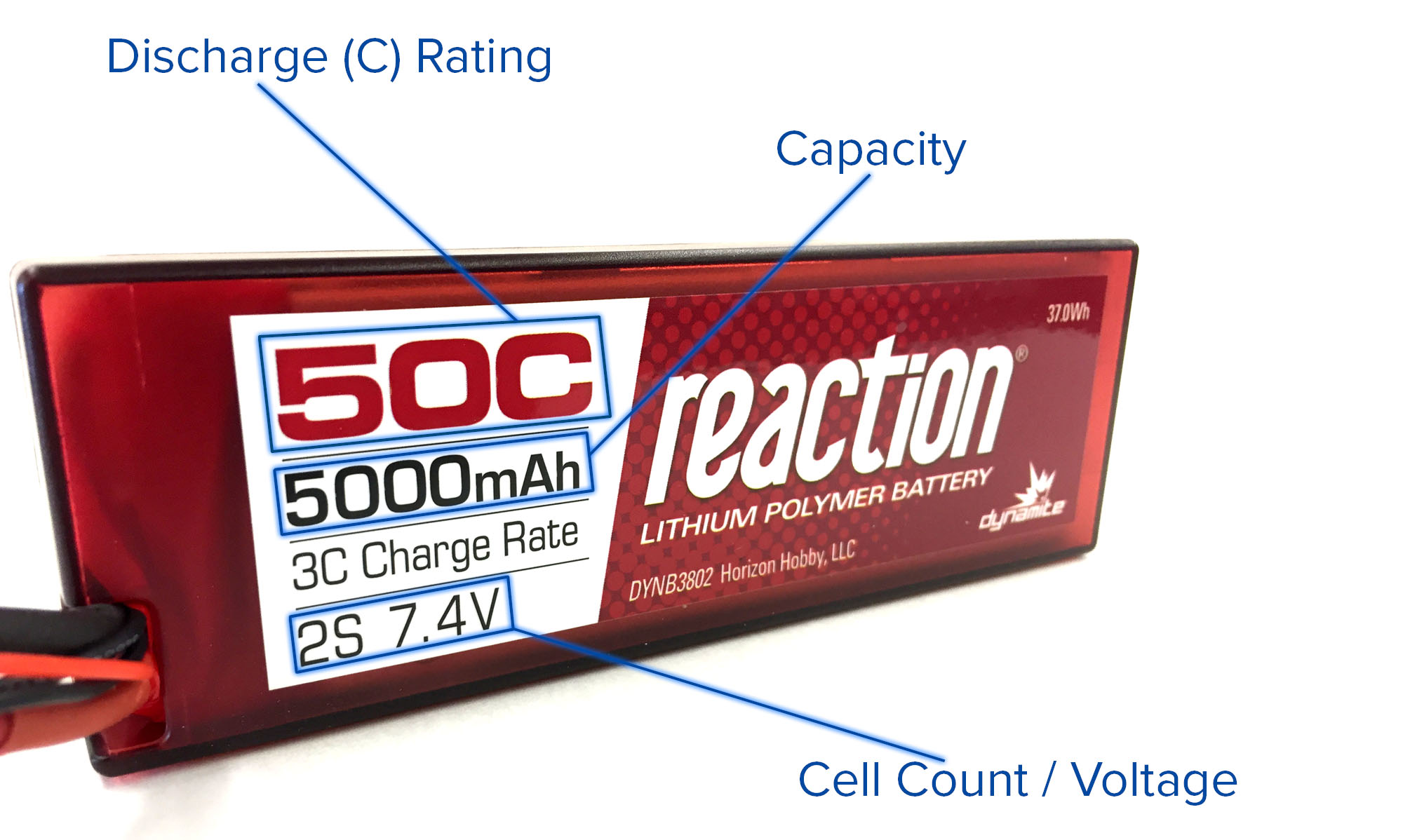
So what does it all mean? Permit's intermission it down and explain each ane.
Voltage / Jail cell Count
A LiPo cell has a nominal voltage of three.7V. For the 7.4V bombardment above, that ways that at that place are ii cells in series (which means the voltage gets added together). This is sometimes why y'all volition hear people talk about a "2S" bombardment pack - it ways that there are 2 cells in Series. So a two-prison cell (2S) pack is seven.4V, a three-cell (3S) pack is 11.1V, and then on.
About Nominal Voltages
I thought (mistakenly) that this was common cognition, but later on a handful of emails on the topic, it was clear I needed to clarify what nominal voltage is.
Nominal voltage is the default, resting voltage of a bombardment pack. This is how the bombardment industry has decided to hash out and compare batteries. It is not, however, the full charge voltage of the jail cell. LiPo batteries are fully charged when they accomplish four.2v/jail cell, and their minimum condom charge, as we volition discuss in detail later, is 3.0v/cell. 3.7v is pretty much in the middle, and that is the nominal accuse of the cell.
In the early days of LiPo batteries, yous might accept seen a battery pack described as "2S2P". This meant that there were actually four cells in the battery; two cells wired in serial, and two more wired into the starting time two batteries in parallel (parallel significant the capacities get added together). This terminology is non used much nowadays; modernistic applied science allows the states to accept the individual cells hold much more energy than they could only a few years ago. Notwithstanding, information technology tin can be handy to know the older terms, just in case you run into something with a few years on information technology.
The voltage of a bombardment pack is essentially going to make up one's mind how fast your vehicle is going to go. Voltage directly influences the RPM of the electric motor (brushless motors are rated by kV, which means 'RPM per Volt'). So if you have a brushless motor with a rating of iii,500kV, that motor will spin 3,500 RPM for every volt you utilise to it. On a 2S LiPo bombardment, that motor will spin effectually 25,900 RPM. On a 3S, information technology will spin a whopping 38,850 RPM. So the more than voltage y'all take, the faster you're going to go.
Capacity
The capacity of a battery is basically a measure of how much power the battery tin hold. Think of it as the size of your fuel tank. The unit of measure out hither is milliamp hours (mAh). This is saying how much drain can be put on the battery to discharge information technology in i hour. Since we ordinarily discuss the drain of a motor system in amps (A), here is the conversion:
1000mAh = 1 Amp Hour (1Ah)
I said that the capacity of the battery is like the fuel tank - which ways the chapters determines how long you tin can run before you have to recharge. The higher the number, the longer the run fourth dimension. Airplanes and helicopters don't really have a standard capacity, because they come in many different sizes, merely for R/C cars and trucks, the average is 5000mAh - that is our most popular battery here in the store. Simply at that place are companies that make batteries with larger capacities. Traxxas even has 1 that is over 12000mAh! That's huge, merely there is a downside to large capacities as well. The bigger the capacity, the bigger the physical size and weight of the battery. Another consideration is heat build upwardly in the motor and speed control over such a long run. Unless periodically checked, you can hands burn upward a motor if it isn't given plenty time to absurd downward, and well-nigh people don't stop during a run to check their motor temps. Continue that in mind when picking upward a battery with a big chapters.
Q: Why do nosotros use voltage, and non capacity, to determine how charged a bombardment is?
A: The reason we use voltage to determine the charge level of a battery stems from our difficulty in measuring chapters. Voltage is simple to measure — if y'all've e'er used a voltmeter to mensurate a AA bombardment, you lot empathize how niggling it is to measure voltage.
Chapters, however, is nearly impossible to measure out accurately. We tin measure how much energy is going into a battery (at to the lowest degree somewhat accurately), but we can't measure how much is actually in the battery.
Think of it similar beakers of water. For voltage, the beaker is transparent, and we can easily meet the amount of water in the beaker in the same style we can measure voltage whenever nosotros like. On the other hand, we have the chalice representing chapters, and it's opaque — we can't see through it, and so the only way to know how much is inside is to empty it and measure the water (energy) as it'south leaving the chalice (bombardment).
Because amperage and voltage are intertwined, equally we will talk over later in detail, the voltage of a battery does correlate, approximately, to the chapters left in the battery, and while there are times when the voltage tin deceive you, in full general, it's okay to rely on voltage as our primary measure of how full a bombardment is.
This question was asked by Donald via electronic mail, and made complete sense to include my reply to him on the guide. Cheers, Donald!
Belch Rating ("C" Rating)
Voltage and Capacity had a direct bear on on certain aspects of the vehicle, whether it'due south speed or run time. This makes them easy to sympathise. The Discharge Rating (I'll exist referring to information technology as the C Rating from at present on) is a bit harder to understand, and this has atomic number 82 to it being the most over-hyped and misunderstood aspects of LiPo batteries.
The C Rating is simply a mensurate of how fast the battery can be discharged safely and without harming the battery. I of the things that makes it complicated is that information technology'southward not a stand-alone number; it requires you lot to likewise know the capacity of the bombardment to ultimately figure out the safe amp draw (the "C" in C Rating actually stands for Capacity). Once you know the capacity, it's pretty much a plug-and-play math problem. Using the above battery, here's the style you find out the maximum safe continuous amp draw:
50C = 50 x Capacity (in Amps)
Calculating the C-Rating of our case battery: fifty 10 v = 250A
The resulting number is the maximum sustained load you can safely put on the battery. Going higher than that will outcome in, at all-time, the degradation of the battery at a faster than normal pace. At worst, information technology could burst into flames. So our instance battery can handle a maximum continuous load of 250A.
Most batteries today accept two C Ratings: a Continuous Rating (which we've been discussing), and a Burst Rating. The Burst rating works the same style, except information technology is only applicable in ten-2nd bursts, non continuously. For example, the Outburst Rating would come into play when accelerating a vehicle, but not when at a steady speed on a straight-away. The Burst Rating is almost ever higher than the Continuous Rating. Batteries are usually compared using the Continuous Rating, not the Burst Rating.
In that location is a lot of vitriolic comments on the Internet almost what C Rating is all-time. Is it best to get the highest y'all can? Or should you get a C Rating that's just plenty to cover your need? In that location isn't a simple answer. All I can give you lot is my have on the event. When I fix a customer with a LiPo battery, I beginning find out what the maximum current his or her application will draw. Let's look at how that works.
Let'southward assume that our example client is purchasing a Slash VXL R/C truck. That motor, according to Traxxas, has a maximum continuous current draw of 65A and a flare-up depict of 100A. Knowing that, I can safely say that a 2S 5000mAh 20C LiPo will be sufficient, and will in fact have more than power than we need. Call up, it has a maximum prophylactic continuous belch rating of 100A, more than plenty to handle the 65A the Velineon motor will draw. Similarly, the Burst Rate of 150A hands covers the 100A the motor could describe.
However, the ratings on the motor aren't the whole moving picture. The way the truck is geared, the terrain the truck is driving on, the size of the tires, the weight of the truck... all of these things have an impact on the final draw on the battery. Information technology's very possible that the final draw on the bombardment is higher than the maximum motor draw. So having that petty bit of overhead is crucial, because you tin can't easily effigy out a hard number that the truck will never become over.
For near applications, a 20C or 25C battery should be fine. But if yous're driving a heavy truck, or you're geared up for racing, or y'all have a big motor for 3D flying applications, yous should probably offset around a 40C bombardment pack. But since there is no easy manner to effigy this out, I encourage you lot to talk to your local hobby shop to have them help determine which bombardment pack is right for your application.
Internal Resistance: The Mystery Number
There is one very of import rating we haven't talked about yet: Internal Resistance (or IR). Trouble is, you lot won't find the IR rating anywhere on the battery. That's because the internal resistance of a battery changes over time, and sometimes because of the temperature. However, just because yous can't read the rating on the battery doesn't mean it isn't important. In a fashion, the internal resistance is ane of the about important ratings for a bombardment.
To understand why the IR is important, we have to sympathise what it is. In simple terms, Internal Resistance is a mensurate of the difficulty a bombardment has delivering its energy to your motor and speed command (or whatever else you have a bombardment hooked upward to). The higher the number, the harder it is for the free energy to attain its preferred destination. The free energy that doesn't "go all the way" is lost as heat. And so the internal resistance is kind of a mensurate of the efficiency of the battery.
Internal Resistance is measured in milliohms (mΩ).
1,000 milliohms is equal to 1 Ohm (Ω)
Measuring the IR of your battery requires a special toolset. You either need a charger that volition measure it for you or a tool that specifically measures internal resistance. Given that the only tool I have plant for this (at least in the hobby world) is almost every bit expensive as a charger that does this for you, I'd go with a charger for this process. Some chargers mensurate each cell's IR separately, and some measure the unabridged battery pack as a whole. Since internal resistance is a cumulative effect, and the cells are wired in series, if y'all have a charger that does each cell independently, you lot demand to add up the IR values of each cell, like this:
Suppose we take a 3S (three-cell) LiPo battery, and the measuring the cells independently yields these results.
Cell one: 3 mΩ Prison cell 2: 5 mΩ Cell three: 4 mΩ
To find the full internal resistance for the battery pack, nosotros would add up the values for the three cells.
iiiΩ + 5Ω + 4Ω = 12 mΩ
For a charger that measures the pack as a whole, all you lot would run into is the 12 mΩ - the residuum would be done for you - backside the scenes, as it were. Either manner, the goal is to have the IR for the entire pack.
The first reason internal resistance is important has to practise with your battery's health. As a LiPo battery is used, a build upward of Li2O forms on the inside terminals of the battery (nosotros'll go more than in depth on this later on in the Discharging section). Every bit that build upwards occurs, the IR goes upwardly, making the battery less efficient. Subsequently many, many uses, the battery volition simply vesture out and be unable to hold on to whatsoever energy you put in during charging - nearly of information technology will exist lost as heat. If you've ever seen a supposed fully charged bombardment belch almost instantly, a high IR is probably to arraign.
To understand how Internal Resistance works in R/C applications, showtime we have to empathise Ohm's Law. It says that the current (Amps) through a usher between two points is directly proportional to the difference in voltage across those ii points. The modern formula is as follows: Amps = Volts / Resistance. In the formula, the resistance is measured in Ohms, not milliohms, then we'd have to convert our measurements. If we use our previous 3S LiPo, and plug it into the equation forth with a 1A depict, we tin detect out how much our battery pack's voltage volition drop as a outcome of the load. Commencement, nosotros have to modify the equation to solve for volts, which would look like this:
Amps 10 Resistance = Volts
Then plugging in our numbers and solving the equation would look like this:
1A x 0.012 Ω = 0.012V
So our battery would experience a tiny drop in voltage when a 1A load is applied. Because our 3S LiPo is effectually 12.6V when fully charged, that'south not a large deal, right? Well, permit'southward see what happens when we increase the load to 10A.
10A x 0.012 Ω = 0.120V
Now we meet that when we increased the load 10X, we also increased the voltage drib 10X. But neither of these examples are very "real world". Let'due south use the Slash VXL from the previous department and plug those numbers in. If you recall, our Velineon motor has a maximum continuous current rating of 65A. Let's assume nosotros manage to hit that marker when driving and use that.
65A x 0.012 Ω = 0.780V
Wow, more than than iii/4 of a volt! That's around 6.2% of the full voltage of our battery pack. Pretty respectable, simply it'southward still a reasonable drop in voltage.
"Then, yeah, the voltage drops. Merely then what? What does that actually mean? How does it effect my R/C vehicle?" Well, permit'due south continue on with our example to show you lot.
The Velineon motor our Slash VXL uses has a Kv rating of 3500. That ways information technology spins 3,500 RPM per volt. On a fully charged 3S LiPo we'll come across this (assuming no voltage driblet):
12.6V ten 3500RPM = 44,100 RPM
Now, assuming we can striking that 65A draw on our unloaded motor (which we can't in real life, but for the purposes of demonstration nosotros can), here'south the RPM on the same motor with our voltage driblet from before:
11.82V x 3500RPM = 41,370 RPM
Difference of two,730 RPM
See the drib in performance? That's the effect Ohm's Constabulary has on our hobby. A lower internal resistance means your car or truck or airplane or gunkhole or helicopter goes faster and has more power.
This begs the question: how low should it be? Unfortunately, there's no easy answer for this. Information technology's all dependant on your apply case and battery. What is great for one battery may be terrible for another. Based on my online research, combined with my own experience and findings, I would say, as a general dominion, a per cell rating of between 0-6 mΩ is as good as it gets. Between seven and 12 mΩ is reasonable. 12 to 20 mΩ is where y'all start to meet the signs of crumbling on a bombardment, and beyond 20mΩ per jail cell, you'll desire to beginning thinking almost retiring the bombardment pack. Only this is only a guide - there is no hard dominion prepare here. And if your charger doesn't give you the per prison cell measurements, you'll have to divide your full count past the number of cells in your battery to go an approximate per cell rating.
Internal Resistance and C-Rating
At that place are many people out at that place that believe a higher C-Rating volition brand their vehicle perform improve. Nosotros know from our previous discussion on C-Ratings that you demand to account for the power draw your motor has when picking out the right C-Rating for your battery, simply does more than equal better? Many people say yes.
Just at that place isn't anything intrinsic to the C-Rating that substantiates their claims. It's simply not truthful that a higher C-Rating makes your auto or plane faster.
However, there is a correlation between the C-Rating of a battery and the internal resistance of that battery. In full general, batteries with a higher C-Rating also have a low internal resistance. This isn't ever the case, as there are always variances in manufacturing, simply the full general idea seems to concur true, and a lower IR volition make a car or airplane faster.
This is a example of correlation not equalling causation. It'southward actually the internal resistance making a battery faster, not the C-Rating.
Proper Care & Treatment: Charging
Bombardment and Balance Lath
Information technology's important to use a LiPo uniform charger for LiPos. As I said in the Introduction, LiPo batteries require specialized intendance. They charge using a arrangement called CC/CV charging. Information technology stands for Constant Current / Constant Fiveoltage. Basically, the charger will keep the current, or charge rate, constant until the bombardment reaches its tiptop voltage (4.2v per cell in a battery pack). Then information technology will maintain that voltage, while reducing the current. On the other mitt, NiMH and NiCd batteries charge best using a pulse charging method. Charging a LiPo bombardment in this way can have damaging furnishings, and so it's important to have a LiPo-compatible charger.
The second reason that y'all need a LiPo-compatible charger is balancing. Balancing is a term nosotros use to depict the human action of equalizing the voltage of each prison cell in a bombardment pack. We balance LiPo batteries to ensure each cell discharges the same corporeality. This helps with the performance of the bombardment. Information technology is as well crucial for safety reasons - but I'll get to that in the department on discharging.
While there are stand up-alone balancers on the market place, I recommend purchasing a charger with built-in balancing capabilities, using a remainder board like the ane pictured to the correct. This simplifies the process of balancing, and requires ane less thing to be purchased. And with the price of chargers with built-in balancers coming downwardly to very reasonable levels, I can't recollect of a reason y'all would non want to simplify your charging fix. Nosotros'll talk more about chargers in the next section.
Most LiPo batteries come up with a connector called a JST-XH connector on the balance tap. Ane of the big problems with this connector is it's lack of expanse; namely, one's inability to get a good grip on the connector. This makes it hard to unplug from a balance board, and a user usually just ends up pulling on the wires. This can break the connector, and potentially brusk out the battery. A unique product, called Balance Protector Clips (or AB Clips) is a great way to solve this problem. They prune around the residuum connector, and give a user more space to grab on to the it. They are usually cheap, and a bang-up way to forbid balance connector fatigue. To the left, you can meet a balance connector with and without the Rest Protector Clips.
Near LiPo batteries need to be charged rather slowly, compared to NiMH or NiCd batteries. While we would routinely charge a 3000mAh NiMH battery at iv or five amps, a LiPo bombardment of the aforementioned capacity should be charged at no more than 3 amps. Just as the C Rating of a battery determines what the safety continuous belch of the battery is, at that place is a C Rating for charging as well. For the vast majority of LiPos, the Accuse Charge per unit is 1C. The equation works the aforementioned way equally the previous belch rating, where 1000mAh = 1A. Then, for a 3000mAh battery, we would want to charge at 3A, for a 5000mAh LiPo, we should prepare the charger at 5A, and for a 4500mAh pack, 4.5A is the correct charge charge per unit.
The safest charge rate for most LiPo batteries is 1C, or ane x capacity of battery in Amps.

Withal, more and more LiPo batteries are coming out these days that advertise faster charging capabilities, like the example battery nosotros had above. On the bombardment, the label says it has a "3C Accuse Rate". Given that the bombardment's capacity is 5000mAh, or 5 Amps, that means the battery tin be safely charged at a maximum of 15 Amps! While it's best to default at a 1C charge charge per unit, ever defer to the battery'south labeling itself to decide the maximum prophylactic charge rate.
Due to the potential for fire when using LiPo batteries, regardless of the likelihood, certain precautions should exist taken. Always have a fire extinguisher nearby; information technology won't put out a LiPo burn down (as I will further explain below, LiPo fires are chemical reactions and are very difficult to put out). But a burn down extinguisher will contain the burn and finish it from spreading. I prefer a CO2 (Carbon Dioxide) extinguisher - it helps to remove oxygen from the burn down site, and volition also cool down the bombardment and surrounding items. Another condom precaution is to charge the LiPo in a fire-resistant container. Almost people opt toward the LiPo Bags on the market place today, like the one pictured to the left. They are a bit pricy, but are more portable than other solutions. Finally, never charge your LiPo batteries unattended! If something does happen, you needs to exist effectually to react quickly. While you don't have to always exist in the same room, you shouldn't exit the business firm, or go mow the lawn, or anything else that volition prevent yous from taking action should the battery catch fire.
NEVER Leave a Battery Charging Unattended!
Picking Out the Right Charger

At the fourth dimension of this writing, I consider the Dynamite Passport P1 Mini Charger (pictured to the left) to be one of the best values on the market. It's a multi-chemical science charger, which ways it can charge NiMH, NiCd, and Atomic number 82 Acid batteries equally well as LiPo batteries. Information technology tin even charge the newest LiFe batteries that some use for receiver packs in airplanes and cars. It has a built-in balancer that handles upward to 4S LiPo batteries and can charge upward to half dozen amps. Information technology'due south a nifty charger for the price. It'south non as high-power equally some LiPo users may need, though, since information technology only operates at sixty watts. And then higher jail cell count batteries may not charge very fast on the P1.
If yous need to charge multiple batteries at the aforementioned time, the Ultra Ability UP240AC Plus charger is probably the best bet. Priced at around $190, it has all the capabilities of the KX80, but with four contained 50W charge ports. This ways you can charge up to four batteries at one time! If yous demand more wattage, the Dynamite Prophet Sport Quad 100W is the fashion to become, with iv 100W charge ports. In fact, we utilize the 100W version as our go-to charger here in the shop.
If y'all have large-chapters batteries, large jail cell counts, or higher charging rates, you may want to observe a charger that operates on college wattages. As mentioned, the P1 Passport Air conditioning/DC charger works on threescore watts (60W). Each port on the Ultra Power quad charger is 60W (if using them all at the same time). What does this hateful to you? Well, let'due south look at how watts, amps, and voltage piece of work together.

Watts = Voltage x Amperage
Run across, wattage, voltage, and amperage are intertwined. You can convert voltage to amperage, and vice-versa. This is important in determining what kind of charger you demand. Let me show you how.
Permit's say that I have a 6S 5000mAh LiPo battery, and I want to accuse information technology at 1C, which would exist 5A. If I accept a KX80 Ac/DC Charger, I can prepare the charger to charge at 5A for a 6S bombardment. But when I go to charge the battery, the nigh it ever charges at is around iii.5A. What gives? If we employ the formula to a higher place, we can plug in our voltage (22.2V) and our Amperage (5A) and we get this:
22.2v x 5A = 111W
So the formula is saying that if we want to charge our 6S 5000mAh LiPo pack at five Amps, we would demand a charger that is capable of delivering at least 111 Watts of power. Our Kinexsis KX80 can simply deliver 80 Watts.
So you lot can see why a higher wattage charger might be important if you lot want to charge larger batteries quickly. For these kinds of chargers, correct at present I'd accept to recommend the Dynamite Passport Ultra Force 220W Affect. (pictured left). Similar the Kinexsis KX80, it's a unmarried-port, multi-chemical science charger. Dissimilar the KX80, though, it is capable of a whopping 220-Watt output, and a accuse rate of upwardly to 15A. Amend yet, unlike many similar chargers of this power, the Passport Ultra Strength is Air-conditioning/DC, so at that place's no additional ability supply to purchase!
As ever, it'due south best to talk to your local hobby shop and have them set up you up with a charger that will fit your needs. Local back up is always a handy thing!
Parallel vs. Series Charging
A wonderful gentleman from holland contacted me recently asking most parallel charging versus series charging. He wanted to know how all-time to accuse half-dozen of his unmarried-jail cell LiPo batteries at the same time. Parallel charging adapters are readily available, so that must be the best way, right?
Absolutely not! Parallel charging tin be very dangerous. Even experts from well-known battery manufacturers "consider parallel pack charging to be highly dangerous and should non be attempted even by experienced users". The problem with parallel charging (or even using your batteries in parallel) is that, when hooking up batteries in parallel, you lot are doubling the chapters of the batteries while, and this is of import, maintaining the voltage of 1 of the individual batteries. What this means is that your charger, which normally monitors the battery while charging to foreclose overcharging, cannot run across all of the individual batteries' voltages - it tin can only run into one.
Another problem with parallel charging is the inequality of the batteries. If the two batteries (and the cells independent therein) were from the exact aforementioned product lot, had the exact aforementioned chemical composition and age and charge history and everything else - in other words, if they were completely identical - parallel charging would be okay. But a consumer (that'south you) volition never exist able to replicate those conditions, or even come close. The more those parameters differ, and considering the questionable balance charging techniques that many battery chargers employ, the higher the chance of over charging and thermal runaway (more on that in the adjacent section).
Just what nigh batteries that are built in parallel? Doesn't the fact that batteries are sometime constructed in parallel mean that parallel charging is condom?
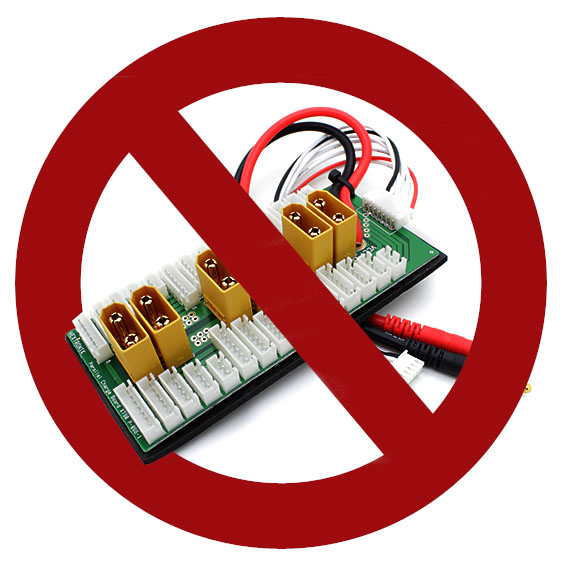
Like I said before, if y'all tin can match all those parameters to exist identical, parallel charging is okay. At the manufacturing plant where they make the packs, manufacturers are constantly monitoring and testing the materials that make upward the cells. Each cell is labelled with a UPC code that contains the entire chemical makeup and history for that cell. When a manufacturer assembles a battery, a computer scans and sorts the cells into compatible matches. Simply so is it prophylactic to parallel charge these cells. However, when you charge a LiPo battery at home, even if it is already constructed in parallel, y'all don't need any fancy parallel charging boards - the piece of work is already done for you, and you lot only need to charge it every bit you would a normal battery.
Please, please, don't use parallel charging cords. At that place is no safe way to utilize these. Parallel charging merely tempts fate. You will be able to find thousands of successful attempts to parallel charge batteries around the web. These are merely people that take not yet managed to fire their dwelling down. Every battery practiced I accept talked to agrees on this.
Series charging is the safer of the two methods (meaning it'southward no less unsafe than directly-upwardly normal charging) IF you set up your charger the right way. If you lot desire to charge six unmarried-cell LiPo batteries — that are even so capacity — you can wire them up in series, prepare your charger as if it were a six-cell LiPo, and balance charge your LiPos. The human action of balance charging them is essentially making the charger individually charge each cell, making sure they are all kept at safe levels. If y'all only have a single-port charger, series charging is the only safe way to charge multiple batteries at the same time, but wiring them up properly is pretty complex and not something a beginner should attempt.
And the absolute best style to accuse multiple batteries at the same time is to have a multi-port charger, like the Dynamite Prophet Sport Quad mentioned in a higher place. If you find yourself needing to charge many batteries at once, practise the smart thing and purchase a charger (or chargers) that will fit your needs.
And thanks to Thiemo for the question!
Proper Intendance & Treatment: Discharging (Using the Battery)
LiPo batteries offering plenty of power and runtime for usa radio control enthusiasts, but that power and runtime comes at a price. LiPo batteries are capable of catching fire if not used properly - they are much more delicate than the older NiMH/NiCd batteries. The trouble comes from the chemical science of the bombardment itself.
Lithium-Polymer batteries contain lithium, an alkali metallic, which reacts with h2o and combusts. When heated, Lithium also combusts when reacting with oxygen. The process of using the battery, in the sometimes extreme ways that we do in the R/C globe, causes at that place to exist backlog atoms of Oxygen and backlog atoms of Lithium on either finish (the cathode or anode) of the battery. This tin and does cause Lithium Oxide (Li2O) to build up on the anode or cathode. Lithium Oxide is basically lithium corrosion, or lithium "rust". The Li2O causes the internal resistance of the battery to increment. The practical result of higher internal resistance is that the battery volition heat up more during use.
College Internal Resistance = Higher Operating Temperature
As we touched on earlier, some mod chargers can read the internal resistance of the battery in milliohms (mΩ). If you lot accept i of these chargers, y'all can go a sense of how your LiPos are performing, and how their internal resistance increases as they age. Simply keep rail of the internal resistance reading each time you charge your battery, and nautical chart the increase over fourth dimension. Yous volition come across how just the process of using the LiPo battery begins to vesture it out.
Heat causes the excess oxygen to build up, and somewhen the LiPo pack begins to bang-up. This is a adept time to cease using the battery - its trying to tell you that it has come to the stop of its life. Further apply can be dangerous. After the pack has swollen, continued utilise tin can cause fifty-fifty more heat to exist generated. At this bespeak, a process called Thermal Runaway occurs.

A Swelled, or Puffed, LiPo
Thermal Runaway is a cocky-sustaining reaction that is accelerated by increased temperature, in plow releasing energy that farther increases temperature. Basically, when this reaction starts, information technology creates rut. This estrus leads to a production that increases resistance (more Li2O), which causes more heat, and the process continues until the bombardment bursts open from the pressure. At this point, the combination of heat, oxygen, and the humidity in the air all react with the lithium, resulting in a very hot and dangerous fire.
Still, fifty-fifty if you stop using the battery when it swells, you still have to render it rubber (a process I'll become into afterward on in the LiPo Disposal section). If you puncture a LiPo that has swollen and all the same has a accuse, it can still grab fire. This is considering the unstable bonds that exist in a charged battery are in search of a more than stable state of existence. That's how a bombardment works; you destroy a stable chemical bond to create an unstable chemic bail. Unstable bonds are more apt to release their energy in the pursuit of a more stable bail.
When a LiPo is punctured, the lithium reacts with the humidity in the atmosphere and heats up the battery. This heat excites the unstable bonds, which break, releasing free energy in the class of heat. The Thermal Delinquent starts, and you once again get a very hot and dangerous fire.
The entire process of building up that lithium oxide, in a perfect world, takes around 300-400 charge/discharge cycles to reach a tipping point. A typical lifetime of a LiPo battery is closer to 150-250 cycles, considering when nosotros oestrus the batteries upward during a run, or belch them lower than iii.0 volts per cell, or physically damage them in any manner, or allow h2o to enter the batteries (and I hateful inside the foil wrapping), information technology reduces the life of the battery, and hastens the build up of Li2O.
In calorie-free of this, most manufacturers accept taken to putting a Low Voltage Cutoff (LVC) on their speed controls. The LVC detects the voltage of the bombardment, and divides that voltage past the jail cell count of the bombardment. So information technology would see a fully charged 2S LiPo as eight.4V, or 4.2V per jail cell.
This is where the advantage of balancing comes in. Considering the speed control does not read off the balance tap, it cannot know the exact voltages of each cell within the battery. The speed control tin only assume that the cells of the battery are all equal. This is important because, every bit I mentioned in a higher place, discharging a LiPo cell lower than 3.0V causes a usually permanent degradation of the cell'due south power to absorb and retain a accuse.
A LiPo cell should NEVER be discharged below iii.0V
The LVC works to cut-off the motor of the vehicle (or in some cases, pulse the motor) to alert yous to a almost-depleted battery pack. It uses the total voltage of the battery as its reference. Nearly LVCs cut-off around 3.2V per cell. For our ii-jail cell case battery, that would exist 6.4V. But if our bombardment isn't balanced, it's possible for the total voltage to exist above the cutoff threshold, even so notwithstanding accept a cell beneath the iii.0V danger zone. One cell could be 3.9V, while the other could be a 2.8V. That'south a total of vi.7V, which means the cut-off would not engage. The vehicle would proceed to operate, allowing you to farther degrade the battery. That's why balancing is then important.
So when running your LiPo, brand sure you have the Low Voltage Cutoff enabled, set correctly, and certainly don't continue to run it afterward the LVC has kicked in! Information technology may exist a slight nuisance, but information technology's worth enduring so that your LiPo batteries remain in practiced wellness.
It's worth noting that about helicopter speed controls and some aeroplane speed controls do not take a Low Voltage Cutoff, as disabling the motor in mid-air wouldn't be a skilful idea. For these kinds of applications, it'southward best to set up a conservative timer (some aircraft radio systems have a timer role built in) and land when the timer goes off. Whether your R/C vehicle has a LVC or non, it'south non a good idea to fly until the bombardment dies!
Proper Care & Handling: Storage
In the old days, we used to run our cars or airplanes until the batteries died, and so just gear up the batteries on the shelf at abode, waiting for the next fourth dimension nosotros could use them. We just stored them expressionless. But you should not exercise that with LiPo batteries. Nor should LiPo batteries be stored at full accuse, either. For the longest life of the batteries, LiPos should exist stored at room temperature at 3.8V per cell. Almost modern computerized chargers have a LiPo Storage part that will either charge the batteries upwards to that voltage, or discharge them down to that voltage, whichever is necessary.
Proper LiPo Storage Voltage = 3.8V per cell
I recommend to our customers that they put their LiPo batteries in storage manner afterward every run. This isn't necessary per se, but it does build up practiced habits. If you do information technology every fourth dimension, you don't have to worry about whether or not you remembered to put information technology in storage. I have had many customers come to me with batteries that died considering they charged it up, intending to apply it, merely life got in the way and they never remembered to put it back to storage voltage. Lithium-Polymer batteries can be damaged by sitting fully charged for every bit little as a calendar week. This doesn't hateful they will become damaged every time you exit them for over a week. It just means they can, and I've seen it happen. So don't forget to put your LiPos at storage voltage when you're done using them.
They should also be stored in a fireproof container of some sort. Equally I mentioned to a higher place, near people tend toward leaving their LiPos in a LiPo bag, as they are portable and protect your workshop from catching fire should the LiPo combust. I accept also seen people utilise empty ammo boxes, fireproof safes, and ceramic flower pots. Whatsoever you have (or can purchase) that will preclude whatever fire from spreading will be worth it in the unlikely event that annihilation untoward should happen.
I feel the need to reiterate: the most common problem people have with LiPo batteries is a directly upshot of improper storage . When a LiPo battery sits for a long period of fourth dimension (and not at proper storage voltage), it tends to discharge itself. If it drops below 3.0V per cell, the vast majority of LiPo chargers will not accuse it. Sometimes, batteries with this trouble can be rehabilitated, but just equally oftentimes, they are a lost cause. Then once again: if you lot take a 'laissez-faire' approach to the storage of your LiPo batteries, it'southward entirely probable that y'all will be purchasing new batteries sooner than you think.
LiPo Battery Disposal
Before disposing of your LiPo, bank check to brand sure the warranty has expired. Some companies take one-year replacement warranties that you can accept reward of, but nearly warranties will be voided if you perform the following steps before seeking a warranty replacement.
So you have a bad LiPo bombardment? No ane really wants to keep them around (fire hazards that they are). So what is the process to go rid of a bad LiPo bombardment safely? Permit's become through information technology.
-
Discharge the LiPo battery as far down as yous safely can. You can practise this a number of ways. Well-nigh computerized LiPo chargers take a discharge feature in them. If y'all don't have a charger with a discharge feature, yous can run downwards the battery in your vehicle - keep in mind that yous take chances a fire and potentially damaging your vehicle doing this, so accept care to have the necessary rubber equipment around. Alternatively, you can build your own discharge rig with a taillight seedling and some wire. Simply solder a male person connector of your choosing to the tabs on a taillight seedling, and plug the battery in. Make sure to have the battery in a fireproof container while doing this.
-
Identify the LiPo in a salt water bath. Mix tabular array common salt into some warm (non hot) water. Go along adding table salt until it will no longer dissolve in the water. Ensure that the wires are all entirely submerged. The salt water is very conductive, and it will substantially short out the battery, further discharging it. Leave the battery in the salt water bath for at least 24 hours.
-
Bank check the voltage of the LiPo. If the voltage of the battery is 0.0V, swell! Move onto the next step. Otherwise, put it back in the common salt h2o bath for another 24 hours. Proceed doing this until the battery reaches 0.0V.
-
Dispose of the bombardment in the trash. That's right - different NiMH and NiCd batteries, LiPos are not chancy to the environment. They can be thrown in the garbage with no problem.
Alternatively, if y'all don't feel like going through this process yourself, you tin can bring the bombardment in to us and we volition dispose of it for you at no price. If yous're not in our area, bank check with your local hobby shop to see if they offer a like service.
Julian from California emailed me to let me know that in his home state, all batteries must be recycled at an authorized battery recycler, so don't throw your LiPo battery in the trash later on discharging it - seek out a recycler. For more than information, see California State'southward Webpage on the Topic.
Thanks, Julian!
Equipping Your LiPo: Proper Connectors
LiPo batteries have all sorts of power just waiting to be unleashed, and we want as much of that power to achieve the motor as possible. But all also oftentimes, I accept customers come in with a not bad LiPo bombardment fastened to a terrible connector. Bad connectors increment resistance and forbid all that power from existence used efficiently. So while it's not specifically about LiPo batteries, let'south talk virtually connectors a lilliputian.
Traxxas Connectors

Traxxas' High Electric current Connectors accept been gaining in popularity over the last few years. These are seen mostly on R/C cars and trucks. The primary appeal of these connectors is the ease of assembly. The terminals are split up from the plastic housing, making them easier for novices to solder. They don't crave heat shrink, as the plastic housing shrouds the terminals completely. They are polarity protected, and so they tin can't be plugged in astern. Recently, Traxxas locked their connectors downwards, and now simply they tin produce batteries with these connectors.
EC3 Connectors

EC3 connectors came onto the scene because Horizon Hobby was looking for a connector to replace the Tamiya connector as its standard plug. So the story goes, Horizon approached Deans with the intent to license the connectors and obtain them at a bulk rate (so they could install them on their batteries at the manufacturing plant). Deans refused to be "reasonable" in negotiations, then Horizon was left to come upwardly with an alternative. They found the EC3 and licensed that connector. From there, it's no surprise that the EC3 spread like wildfire. While they aren't much fun to assemble, they have a sizeable foothold in the R/C airplane market.
Deans Connectors

Deans Connectors are really the king of connectors. They've been around seemingly forever, and have been the elevation choice for the discerning R/C enthusiast for quite some time now. They are somewhat difficult to solder, peculiarly for novice users. Deans connectors slide together smoothly, and are very well designed. Like almost every modernistic connector, they are polarity protected. Currently, they are neck-and-neck with Traxxas connectors for the championship of most pop connector - Traxxas has the border in the R/C surface category, but Deans dominates in the air.
Tamiya Connectors

Only through the shear force of Tamiya'south market place share did these connectors take on their proper name. Originally called a 'Molex' connector, these connectors were the de facto standard of the hobby industry for years. Popularized by Tamiya in their bazillion R/C cars, these connectors came on every vehicle until very, very recently. Even today, some R/C manufacturers still utilize the Tamiya connector on their vehicles (Axial, I'm looking at you). This is a terrible connector with lots of resistance. You lot are more probable to cook these connectors than anything else. If you have a LiPo that has a Tamiya connector on information technology, cut it off and solder on one of the above connectors.
XT-lx Connectors
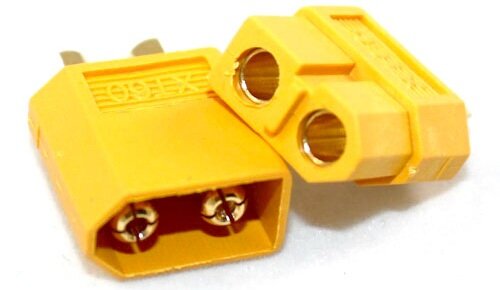
XT-60s accept gained a niggling bit of ground in the last few years. And so far every bit I can tell, they were developed by a Chinese company called AMASS, and then HobbyKing either purchased or licensed the patent from them. But any their origin story is, the XT-60 connector is getting some adoption due to their prevalence on the LiPo batteries coming straight out of China. As far as I know, there aren't many domestic bombardment manufacturers that utilise the XT-sixty plug every bit their default. I practice like the plug; information technology's easy to solder to. It'south relatively pocket-sized and compact besides. It's not my favorite, but I don't heed these connectors. You could do worse.
Anderson Ability Poles

These connectors were widespread in the early on days of radio control. Every bit most of our stuff is borrowed from other industries, Anderson Power Poles are no different. Originally designed by the ham radio industry for their 12V DC standard connector, they were rapidly adopted in the radio control customs. Power Poles are the only plug on this listing that is hermaphroditic, meaning that the plug is neither male or female person. They are all the same - so no worrying about which gender plug goes on the battery or the speed control. They're much rarer in the R/C globe today, but they are probably my favorite plug. They do take upwardly a lot of room, though, and as such, may non be useful in many applications.
Now let'southward talk most balancing plugs. There are many dissimilar plugs here as well, only there are only two chief plugs.
Thunder Power (TP) Plugs
JST-XH Plug
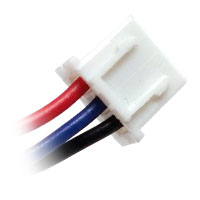

This plug is as shut to an industry standard every bit we will ever have in a residue plug. It comes on most all the major brands, from Traxxas and Venom to E-Flite and Duratrax. Virtually of the cheap battery places out of Mainland china use this plug equally well. While it'due south non quite every bit nice equally the Thunder Ability plug beneath, it's ubiquitous, and that makes it the logical choice for these brands. At that place are very few manufacturers that don't apply the JST-XH plug for their residue lead. Only make sure to unplug it by grasping the plastic housing. Pulling on the wires will almost certainly pull the wires out of the housing, potentially shorting the battery out.
I bemoaned Thunder Power's choice of balance connector for years. Thunder Power makes some of the nicest (and well-nigh expensive) LiPo packs in the industry, but their connector is not compatible with 95% of the chargers on the market, at to the lowest degree out of the box (nigh chargers volition require an adapter from the more common JST-XH to the TP connector). That having been said, it's a nicer design, with a little clip on the top of the plug, assuasive the user to unplug the connector much more than easily. Information technology's difficult for me to recommend this connector, as information technology's only used on Thunder Power and Flite Ability bombardment packs. Only I'll begrudgingly admit it's a ameliorate plug than the JST-XH.
On Soldering...
Another reader, Aaron, emailed me, suggesting a section on soldering — what to do, what not to exercise, etc. I thought this sounded like a bang-up idea. Soldering is equally much an art every bit it is a tool, and there is a right manner to solder when you lot're talking about battery packs.
Never Cut Your Positive and Negative Wires at the Same Time: This is a great style to damage your battery pack and risk a burn. Cutting both wires at the same time will short out the bombardment pack, which will generate a lot of rut. Think of information technology this way — when a welder completes a circuit and welds two pieces of metal together, that's called Arc Welding — and the same principal is at play in Arc Welding as it would exist when you touch positive and negative on your battery together. Cut, solder, and estrus-shrink (if necessary) one wire at a fourth dimension. It might take a little longer, but it'southward far and abroad the safest way to solder a battery.
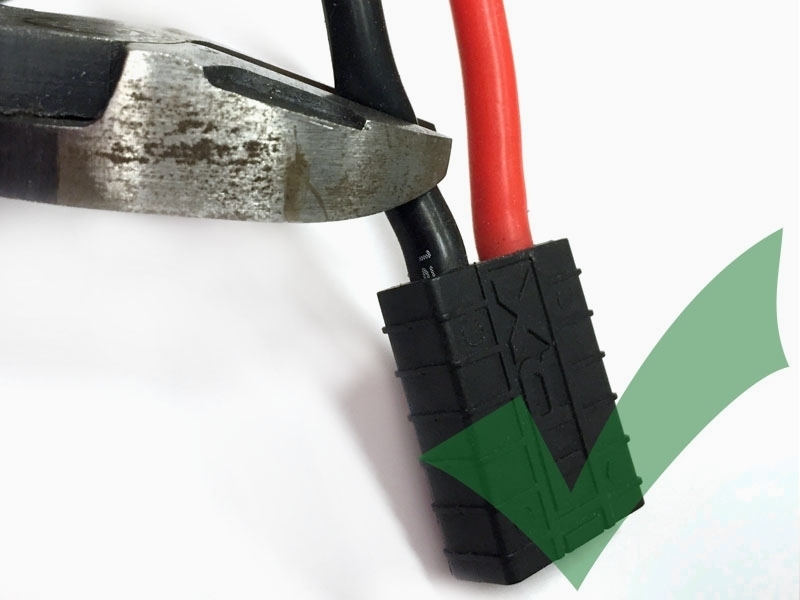

Go Your Polarity Right: One cinch way to destroy a speed command is to solder your connector on backwards. Reversing the polarity is never a good idea. Be mindful of the markings on the connector — nigh brands include a simple "+" for positive and "-" for negative to bespeak which contact is which. Red is positive and blackness is negative. If your bombardment or speed command (or whatsoever you happen to be soldering) doesn't use the cerise/blackness paradigm, commonly the lightest color wire is positive and the darkest is negative. If both wires are black, look for one of them to have white dashes on information technology — that's the positive wire.
Those are some bones safety tips on soldering. If you're not happy with your ability to solder, go along at information technology! I went from the worst solderer in our store to the all-time simply by practicing and taking pride in my work. Similar I said above, soldering is as much an art as it is a tool. Keep working at information technology and somewhen you'll be amazed at how nice your solder joints look!
Thanks to Aaron for the suggestion!
Conclusion
So there y'all accept it - at present you know nearly of what you lot need to know about LiPo batteries. I make no claims that this article teaches you everything there is to know most LiPos, merely hopefully, it helps give you some insight into how they piece of work. LiPo batteries have the potential to overtake NiMH batteries in general use in the next few years, quicker than any bombardment in history. Information technology is certainly an exciting time for the hobby, and things are changing on a frequent footing. Merely remember to have fun, and if you don't know something, inquire questions! Find your local hobby shop or R/C club — or fifty-fifty mail your question to one of the hundreds of R/C message boards on the interwebs. The only dumb question is the one you don't ask!
Change Log
This guide is a living document. As such, information technology will change as new information comes out regarding any relevant topic this guide covers. This is a listing of changes and updates made to this guide.
-
05/26/12 - Guide published.
-
12/24/12 - Guide moved to new URL.
-
01/25/14 - Guide revamped and re-organized; added section on chargers; added XT-60s to connector section; updated images.
-
02/26/14 - Added section on parallel vs. series charging.
-
03/29/14 - Added section on internal resistance.
-
03/02/15 - Removed department on parallel vs. serial charging due to concerns of inaccuracy. Will exist re-instated at a later date.
-
03/04/fifteen - Reinstated parallel vs series charging section. Inaccuracy criticisms proved to be imitation.
-
04/18/15 - Updated parallel vs. series charging to reflect that all batteries must be same chapters to series charge.
-
07/31/xv - Added department on soldering.
-
06/01/sixteen - Added section on nominal voltage.
-
02/24/17 - Added section on California battery recycling laws.
-
03/24/17 - Added subsection "Why do we use voltage, and non capacity, to decide how charged a battery is?".
-
12/twenty/18 - Edited for brevity and clarity.
-
10/12/19 - Removed section on Venom Connectors (no longer relevant).
-
03/27/21 - Edited for brevity and clarity.
-
10/09/21 - Added Amazon Affiliate links.
Check out our Charger Guides for aid using your charger!


 | Brian Schneider / Brian was the manager, webmaster, & social media guru for Roger'due south Hobby Centre for 17 years. |
andersonkillaimpon.blogspot.com
Source: https://rogershobbycenter.com/lipoguide
0 Response to "What Are the Readings on a Multimeter for a 2s Lipo Battery Should Read"
Publicar un comentario